
Autonomous Medical Coding
Autonomous Medical Coding Software Turns Encounters Into Coded Claims in Seconds
Linx AI assigns ICD-10 and CPT codes from any form of encounter data and applies your coding rules. Your queues are ready to review when you sign in.
TRUSTED BY LEADING CODING TEAMS AND PARTNERS



The real cost of manual coding
Quick answer
What is autonomous medical coding?
Linx AI is autonomous AI medical coding software that reads unstructured clinical notes and assigns ICD-10 and CPT codes automatically. It shifts coders from data entry to review, applies your compendium and payer rules, and learns from every correction your team makes.
- Accuracy: 80%+ ready-to-bill by day 30
- Cost: 50%+ lower coding cost per chart
- Compliance: HIPAA, SOC 2 Type II, HITRUST-aligned
- Integrations: Major EHR and billing systems via FHIR + API
- Deployment: Live in 30 days, no workflow overhaul
- Edits: NCCI, LCD/NCD validation built in
See it in action
From report to ready-to-bill.
Key benefits
Lower DNFB. Lower cost per chart. Higher net revenue.
Days in AR ↓ · DNFB ↓
Cut DNFB and days in AR
Linx AI codes charts the moment they're signed, so the DNFB pile stops growing and cash starts moving on the encounters you've already delivered.
50%+ lower coding cost
Tackle cost per chart
The coder shortage isn't just a capacity problem, it's a cost problem. Linx AI absorbs routine volume so your fully-loaded cost per chart drops, even as patient volume grows.
Net revenue uplift
Catch missed codes
Throughput and accuracy are inseparable. Linx AI flags undercoding, missed modifiers, and supporting codes that get skipped under time pressure, translating directly to net revenue improvement.
Key features
Medical coding automation built around how your team actually codes.
Your knowledge, encoded
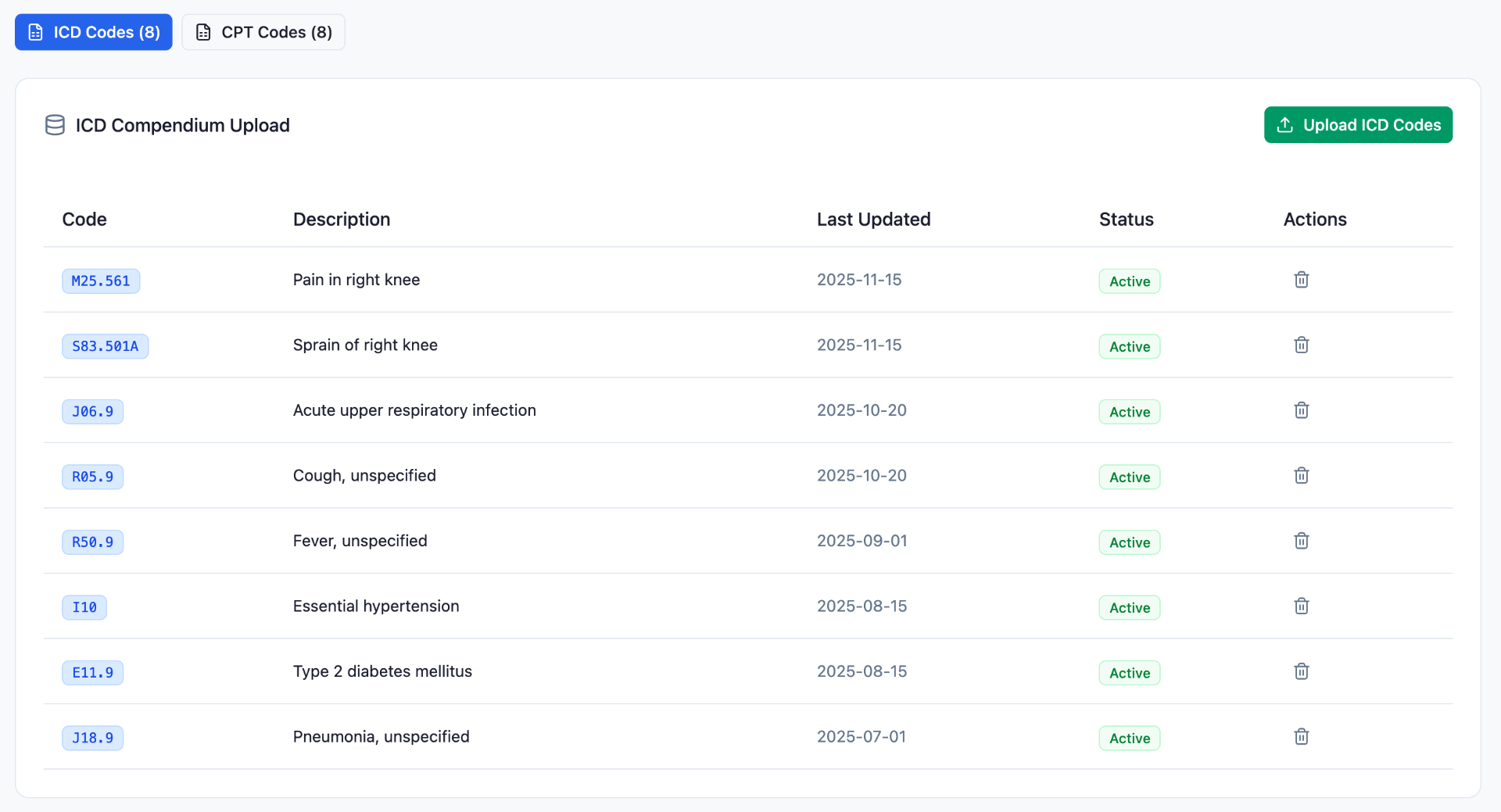
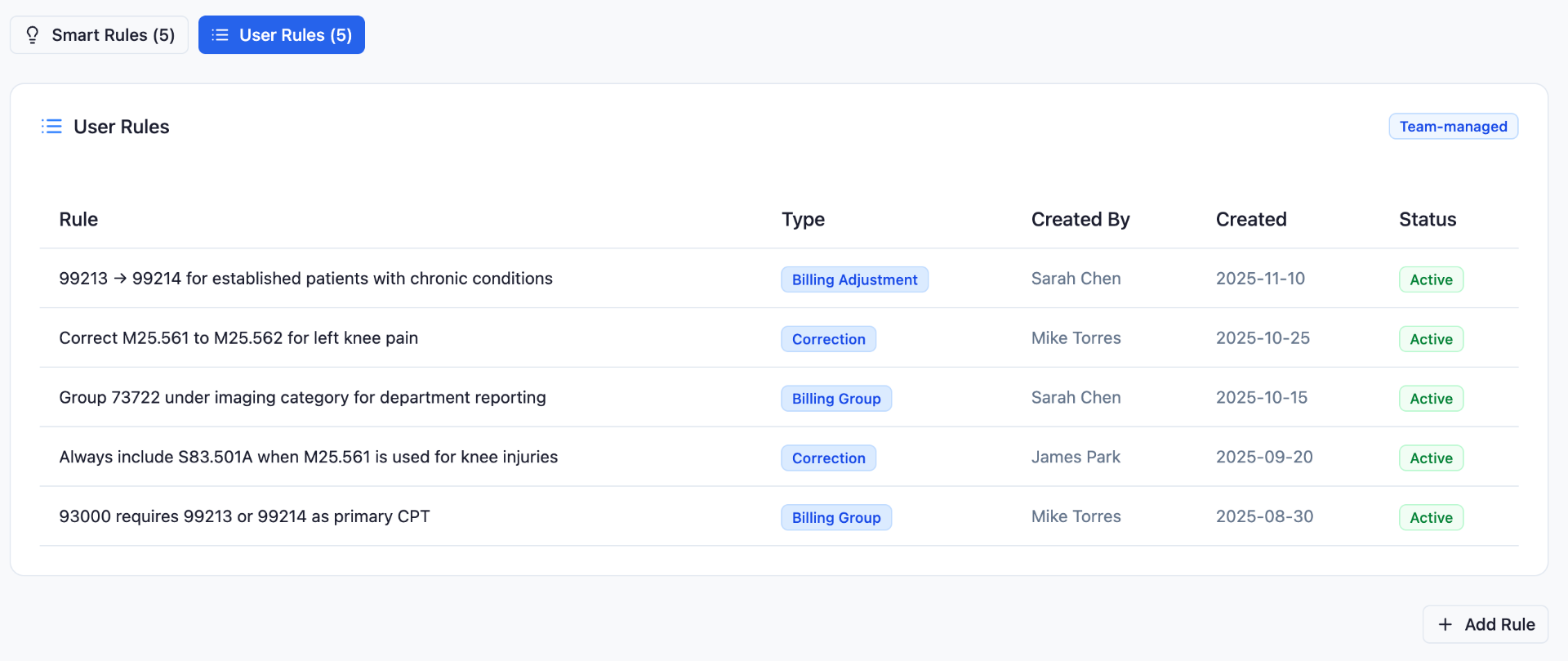
Add your own compendium
Upload your internal coding guidelines, payer-specific rules, and historical decisions. Linx AI applies your compendium on every report so the AI codes the way your team already does.
Your team stays in control
Corrections become approved rules, not silent retraining
When your billers correct a code, Linx AI captures the edit as a proposed rule your team reviews and approves before it applies to future encounters. Rules are versioned per customer and your data stays isolated - no cross-customer training, no black-box drift.
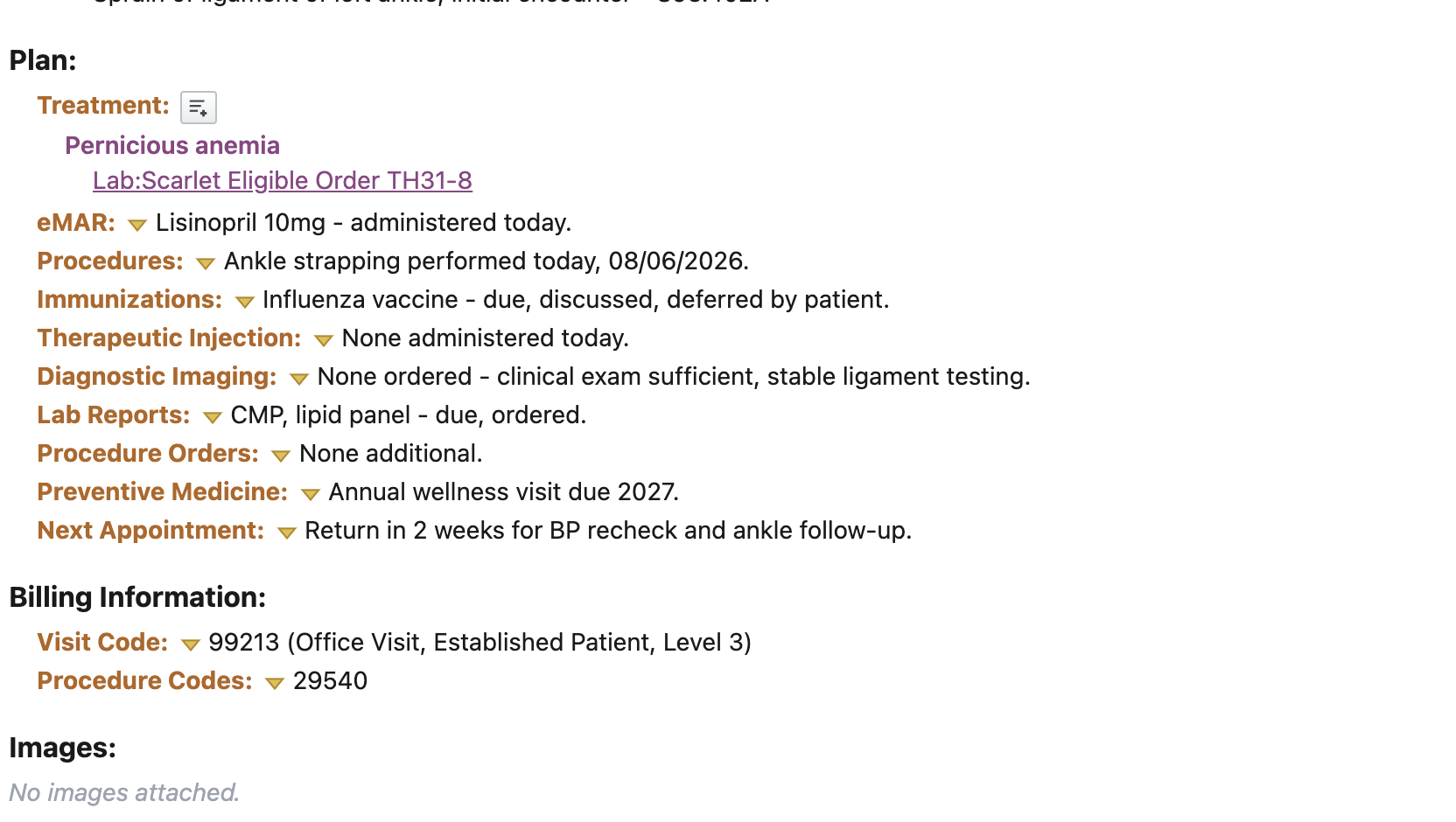
Native to your workflow
Works where you work
Linx AI plugs into your existing workflow, posting to your EHR and billing platforms. No new tabs, no context switching. Pre-coded reports show up in the queue your team already uses.
Built for
Teams that code from clinical notes at scale
Private Practices
Teams dealing with growing patient volumes or staffing constraints
Complex specialty groups
Custom clinical workflows and modifier billing
RCM companies & MSOs
Scalable coding capacity for diverse medical clients
Client result
High-volume imaging group clears a 30-day coding backlog in 30 days.
A high-volume imaging practice group came to Linx AI with a coding backlog that had grown to 30 days, creating a cash flow problem with compliance deadlines approaching. Within the first month of deployment the backlog was cleared, and their team shifted from inputting codes from scratch to reviewing pre-coded charts.
- Scope
- Multi-site outpatient imaging, all modalities
- Volume
- Tens of thousands of encounters per month
- Baseline
- ~30-day DNFB backlog before Linx AI
- Coding team
- Existing in-house coders, no added headcount
- EHR / billing
- Integrated via API into existing systems
- Measurement window
- First 30 days post go-live
Specialty coverage
Specialties live on Linx AI today
Each specialty has its own compendium, rule set, and encounter-type coverage. New specialties are onboarded by ingesting your compendium and historical coded charts, not by training a new model from scratch.
Don't see your specialty?
Security & governance
Built for compliance teams that have to defend the workflow
HIPAA compliant
PHI encrypted in transit (TLS 1.2+) and at rest (AES-256). Role-based access controls, MFA, and audit logging on every PHI access.
SOC 2 Type II
Independent SOC 2 Type II report available under NDA. HITRUST-aligned control mapping for enterprise procurement.
BAA available on request
We sign a Business Associate Agreement with every customer before ingesting PHI. Breach-response timelines documented in onboarding.
Per-customer data isolation
Your compendium, corrections, and encounters stay logically isolated. No cross-customer model training on your PHI.
Model & rule governance
Every code decision carries the model version and the rule that produced it. Rule changes go through your team's review before applying.
Auditability by design
Rationales, source-text citations, and confidence scores are stored per encounter so compliance can reconstruct decisions months later.
Unstructured text capabilities
AI medical coding software built for the edge cases that break generic tools
Clinical context code selection
CPT codes vary by clinical context and documentation details. Linx AI automatically extracts the correct code tier.
Modifier & detail precision
Modifiers 59, 25, RT/LT, and complexity modifiers are evaluated for applicability, with uncertain cases routed to a human reviewer.
Exploding codes & code shortcuts
Auto-expands grouped procedures into their full component codes and applies your team's shortcuts so common charts code in a single click.
Comparison
How Linx AI compares on medical coding automation
| Dimension | Enterprise coding vendors | Linx AI |
|---|---|---|
| Focus | Large health systems | Practices, specialty groups, RCM companies, MSOs |
| Custom rules | Vendor-managed coding logic | Your compendium and payer rules, versioned and inspectable |
| Implementation | Enterprise-length cycles | Two weeks per specialty |
| EHR fit | Enterprise integration programs | Platform-agnostic via FHIR, HL7, REST, or file drop |
| Ambient scribe | Separate product or vendor | Scribe feeds the same coding engine |
Evaluating a specific vendor? See the full comparisons for Fathom Health, CodaMetrix, Nym Health, Arintra, and AKASA, or browse all vendor comparisons.
Related resources
Go deeper on autonomous medical coding.
How to evaluate AI coding vendors
The buyer's checklist: autonomy vs. accuracy, compliance, integration, and pricing traps.
Read moreDirect-to-bill autonomy rate explained
The single most important metric in AI medical coding, and how to measure it honestly.
Read moreClean claim rate benchmarks
How AI-coded claims perform post-submission, with data from live radiology deployments.
Read moreWhy claims get denied in 2026
The top denial reasons and how upstream coding fixes them.
Read moreAI coding for eClinicalWorks
A practical guide to layering autonomous coding on top of eCW.
Read moreCustomer case studies
Production outcomes from imaging, cardiology, and multi-specialty groups.
Read moreFrequently asked questions